Since late July, the bay-side sidewalk on Beach Road has been fenced off. The Beach Road Stabilization Project began work on July 27 and is scheduled to run through October 30, driving steel sheet piles roughly 32 feet down along three sections of the sea wall between Main Street and Peninsula Road. Traffic drops to a single lane at times, parking is restricted, flaggers appear when needed, and the sidewalk and parking lane stay closed for the duration. Gangways to the bayside buildings remain open.
Which means that for about six more weeks, the flattest, easiest, most automatic walk in Belvedere is unavailable. What residents have done in response is the interesting part: they have gone up. And the network they have gone up into is not the quaint curiosity that visiting blogs describe. It is the city's other pedestrian system, and over the past two years it has been surveyed, databased, prioritized and funded like the infrastructure it actually is.
Three numbers, three different things
Ask around about how many lanes Belvedere has and you will get three answers, all of them correct.
The Parks, Open Spaces and Lanes Committee identifies 29 historically mapped lanes, the number that came out of its year-long survey and that anchors the tracking tool now used to rank repairs. The city itself oversees 23 lanes as maintained property, alongside four parks, the playground and assorted open space. And the February fun run covers 18, because that is how many a person can realistically string together in four miles without doubling back forever.
The gap between 29 and 23 is the whole story of the lanes. Some were platted in 1890 and built for summer people arriving by boat who needed a way up the hill to their houses. Some were absorbed, overgrown or simply lost. The survey was the first systematic attempt to write down which is which, and what condition the survivors are in.
Chair Charlie Harrington brought the findings to the City Council on February 9. Mayor Sally Wilkinson's assessment of how the committee used to operate was blunt:
"In the past, it used to be loosey-goosey, wanting a million things."
Staying focused on a short list, she said, has worked.
The 2026 repair queue, read as a trail report
The committee framed this year around a theme it calls "Inform and Improve." The "improve" half is a prioritized list city staff is working through, and if you read it the way a hiker reads a trail report rather than the way a taxpayer reads a budget, it tells you exactly what you will find underfoot this month.
| Work queued in 2026 | Lanes named | What to expect on the ground |
|---|---|---|
| Handrail repair and replacement | Lower McLean, Upper McLean, Corinthian | Railings that are missing, loose or scheduled to come out. The steep sections are steep |
| Concrete stair repair | Lower Cedar, Lower Woodland, Upper Woodland, Corinthian | Cracked and settled treads. Fine in daylight, less fine at dusk |
| Tree work | Upper Cedar, Pagoda, Lower Hawthorne at Centennial Park, Park Lane | Canopy and limb work, with intermittent access interruptions |
Corinthian Island's lane earns a place on two of the three lists, which is worth knowing before you route a morning walk across the causeway. Pagoda is the tree-work lane most likely to surprise you, since it is also one of the longest flights on the island at 195 steps.
Here is the detail almost nobody outside the committee catches. The February annual report noted completed repairs on Cedar Lane, Park Lane and Woodland Lane, yet Lower Cedar, Lower Woodland and Upper Woodland all appear on this year's stair-repair list. That is not a contradiction. Belvedere's longer lanes are split into segments, upper and lower, each with its own sign and its own maintenance history. Cedar, McLean, Woodwardia and Woodland all work this way. "Woodland Lane was repaired" can be true while the flight you personally use is still waiting its turn. When a neighbor tells you a lane has been fixed, the useful follow-up question is which half.
What is finished, and worth the climb this fall
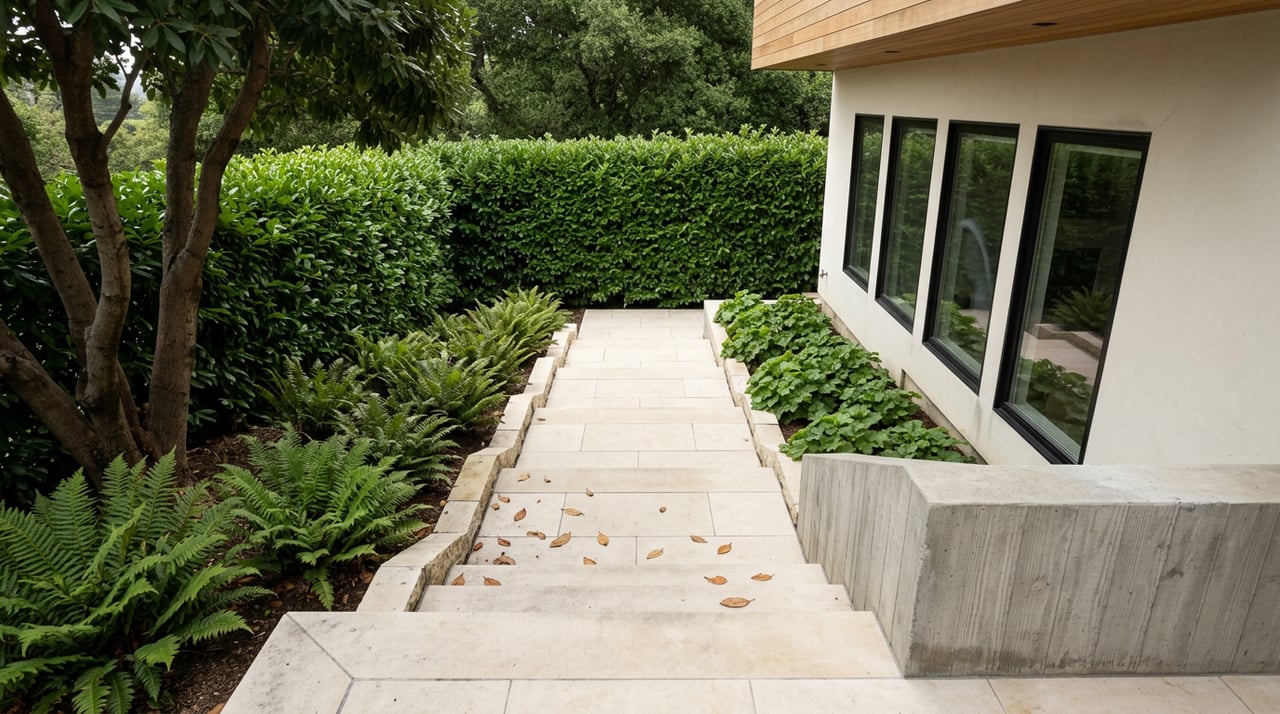
- Park Lane. The staircase renovation is complete, including a new bench sited for Golden Gate Bridge viewing. The lower flight was rebuilt and reconfigured rather than patched.
- Golden Gate Lane. Formerly Eucalyptus Lane, restored and reopened in 2020, running from the 300 block of Golden Gate Avenue down 180 steps to Belvedere Avenue. The Belvedere Community Foundation handed the city a check for $194,500 toward it, combining a $50,000 grant with private gifts.
- Lower Hawthorne at Centennial Park. Tree work is queued, but the small landings and benches partway up remain the most pleasant sit on the island that is not attached to somebody's house.
- Pomander Walk. Four steps. Include it for completeness, and because a four-step lane on the same list as a 195-step lane is a fair summary of how unsystematic this network is.
The "secret" part is a signage problem, not a mystery
Outsiders call them secret stairways. Residents call them the lanes. The difference is that residents know where the entrances are, and the reason anyone else needs a guide is that the wayfinding system is a set of hand-painted wooden signs, each one different, each one made at a volunteer painting party. The idea came from Belvedere artist Diana Bradley, who proposed using wood and took it to the City Council; Virginia Doyle led later rounds. The signs are genuinely lovely and they are also the only thing standing between a visitor and a locked-looking gap between two hedges.
The survey counted missing signs alongside failing stairs and deteriorating railings, which tells you the city now treats findability as a maintenance category. That is the "inform" half of this year's theme: a standalone Belvedere walking map, printed, handed out at public events and available at City Hall, plus a website hub. As of this writing it has not been published. When it lands it will be the first official map of a network that has existed since 1890, which is a strange sentence to write about a city that has been mapping its own lanes in committee minutes for years.
Artist's View is coming, but not yet
The one genuinely new destination on the island is the viewing deck at Artist's View, the city-owned open space near the southern end of Belvedere Avenue. The approved design is modest by intention: a platform 10.5 feet deep and 16 feet wide, cantilevered out and oriented toward Angel Island, funded by a Proposition 68 grant that carries an ADA-compliance requirement.
It took six years and several larger proposals to get there. The Planning Commission approved the deck on July 15, and in December the Council unanimously ratified an agreement with the adjacent property owner that resolved the standoff. In exchange for no legal challenge, the city committed to build nothing else on the site, no structures, paths, trails, huts or hardscape, until at least February 20, 2043. The deck project went out to bid this summer with proposals due July 30. In February the committee projected completion by summer. Bid timing says otherwise, so treat it as a fall-or-later arrival and do not plan a walk around it yet.
February is when the whole thing gets walked at once
The fourth annual Belvedere Challenge ran on February 7 this year: four miles, 18 lanes, starting on the island and finishing at Sam's Anchor Cafe in Tiburon, organized by Harrington in his capacity as a resident more than as committee chair. Entry money goes to lane preservation. The registration ritual is the tell about how this town operates: sign up, sign a waiver, and bring a genuine $2 bill on race day. The $2 bills plus a charity auction at Sam's raised more than $2,000 the prior year. There is a walkers' route for people who have no intention of climbing 195 steps, and it stops at the playground on the way.
Three months of closed sidewalk on Beach Road did not create any of this. It just removed the easy alternative long enough for the rest of it to become visible. A city that spent a year cataloguing 29 flights of stairs, then published a repair list naming each one, is a city that has decided its most-used pedestrian routes run vertically.
If you have been reconsidering how your own house sits in all of this, whether the lane at the end of your street is an asset you have never once mentioned or a maintenance question you would rather understand before a buyer raises it, that is a conversation worth having early and quietly. Matt Knight and Justin O'Reilly know this peninsula street by street and lane by lane. Request a confidential market consultation.